Listening to a Woman in Crisis
What to say to Woman in Crisis?
When faced with a life altering situation, what we say and how we listen can be the difference that changes the course of someone’s future. A woman facing a crisis pregnancy is experiencing emotional turmoil and is in need of support and understanding. Do you know what you would say? Would you know how to constructively listen in a way that helps her as she needs it most?
The Sisters of Life are an order of Catholic nuns dedicated to helping women through what might be the most difficult moment of their lives: an unplanned pregnancy. They are educated as licensed counselors and social workers and work directly with women in crisis.
Understanding a Woman in Crisis

According to the sisters, women experience a profound and overwhelming sense of vulnerability when they are unexpectedly pregnant. “This experience of vulnerability can lead to a deep identity crisis, which can cause a woman to enter into a mode of self-preservation. Without the accompaniment of someone who will accept her in her vulnerability and believe in her, she might see abortion as her only option.”
The sisters are unique in that they see the woman – even before they see the child. Quoting the sisters again “At the heart of what it means to be pro-life is to see the goodness, the beauty, the capacity in each of the women who come to us; to reflect back to her the truth of her identity, so that she can make an act of faith in herself—and incorporate motherhood into her self-identity.”
They explain that “Only by understanding [their] real fears can we open our hearts to receive her, love her, help her to recognize her own goodness, and empower her to make an act of faith in herself.”
That is the mindset we must try to start from – not pressure or guilt or preaching or shaming. But seeing the scared woman who feels she has no choice. We start by listening.
The Art of Listening Well
According to Sister Amata Filia, SV “how we speak and listen to others is essential to the health of a relationship,” and that “the primary work of accompaniment is listening with the ears of the heart.”
But listening well is not something that comes naturally - and it is not just verbal. It involves micro-messaging such as eye contact, body language, silence that conveys patience, and verbal/physical cues such as nodding and tone of voice. Good listening requires empathy, without applying the filter of our own experience, judgment, values, and needs. Listening well to another opens a beautiful space for the Holy Spirit to work in the situation.
Steven Covey’s 5 Levels of Listening from his book The 7 Habits of Highly Effective People offers a good overview of the levels of listening from the least effective to the most effective. These are useful in any situation you may find yourself in where you are being asked to listen.
1. Ignoring:
The first of the five levels of listening is ignoring. This sounds like the opposite of listening -but it is a response to what someone else is saying or trying to communicate. At this level, we aren’t really listening at all..
2. Pretend Listening
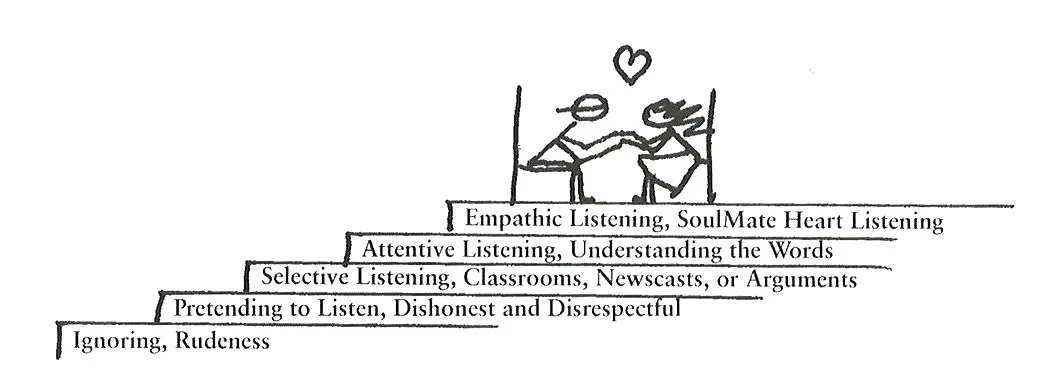
Pretend listening is almost as bad - when we use body language to try to show the other person that we’re engaged but we are really not. Or we allow distractions to pull our attention away, i.e., the phone, laundry buzzer, news feed on the TV. 3.
3. Selective Listening
Selective listening is a step in the right direction. But, while we show we’re listening through eye contact and our body language, we still only hear the parts of the conversation that interest us and stop listening to the parts that don’t. We are more quick to jump in and try to solve the situation we think needs to be fixed and not get to the underlying issue.
4. Attentive Listening
Attentive listening means paying attention and reflecting back what is being said, but includes that dangerous pitfall of making the conversation about ourselves. We have to be careful not to focus on what we might do and our related experience. It is her story.
5. Empathic Listening
Empathetic listening is the level that we strive for during conversations with women in crisis. At this level, we listen to understand her background and motivations while responding appropriately and asking open ended questions. It requires the most mental and emotional energy because it forces us to focus on the other party’s reference using our ears, heart, and brain. This type of listening can help us form a response that resonates with the woman in a way she may never have experienced before. It is helping her see that she has more power than she knows.
What Not to do
On the flip side, here are some things we try never to do when talking with a woman in crisis.
1. Don’t make it about you! She is overwhelmed with processing her situation and emotions. Be a safe place, don’t make her have to process your emotions too. The goal is to empower her to see herself as capable and worthy.
2. Don’t use guilt and shame as a motivator. Don’t make her feel like she has to protect herself from you. In many cases the woman feels shame already – remember the abortion is supposed to hide her shame.
3. Don’t use phrases like “you’re going to kill your baby” or “abortion is murder”. She doesn’t want to choose abortion, but it currently feels like it’s her only choice.
4. Don’t give up on her. Even if she resists talking and even if she is hateful, she needs to know that she is loved. Reinforce that you are there for her. You want what is best for her.
So, what happens if she still chooses abortion? You love her, and offer her help if she needs it post-abortion or if she ever gets pregnant in the future. We try to show them the love and respect they deserve to empower them to love and respect themselves.
Many of us experience fear upon entering into the crisis of another. It isn’t a lack of competence however, but a lack of confidence. The overarching requirement is to love the person in crisis - that is the actual life saving power.